
Battery Recycling in Manchester
Battery recycling collections for fleets, retailers and workplaces in Manchester – lead-acid, lithium-ion and portable batteries, on a one-off or regular basis.
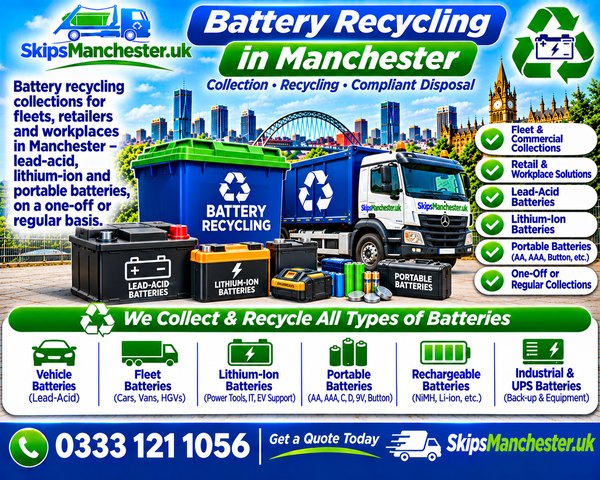
A working building is full of batteries: weighty lead-acid units in vehicles, forklifts and UPS systems, lithium-ion batteries in handheld scanners, rechargeable packs in cordless tools, and the AA and AAA cells that power clickers and remotes. Skips Manchester arranges battery recycling collections across Manchester for organisations and businesses; our licensed team carries out the work and sends the batteries on for proper recovery.
Commercial quantities are the main focus – a facilities team emptying a plant room, spent vehicle batteries at a fleet depot, a customer take-back box in a shop, or a workplace collection point that takes a few months to fill. For the odd household battery, a council or in-store collection point is the better route.
When you ask for a quote, any batteries and equipment containing batteries have to be declared: tell us the types, approximate weights or quantities, and whether anything is damaged. Contact us or use the quote form on this page.
Battery Recycling services
Batteries commonly collected from businesses
Knowing what you have is useful, because each chemistry is dealt with in its own way. Business collections usually involve:
- Lead-acid batteries from vehicles, forklifts and other industrial equipment
- Sealed lead-acid batteries out of alarm panels and UPS systems
- Nickel-cadmium and nickel-metal hydride rechargeables
- Lithium-ion packs out of cordless tools, scanners, phones and laptops
- Portable batteries – button cells, 9V, D, C, AAA and AA
In England, lead-acid batteries and certain other types count as hazardous waste, so we supply a consignment note for them to travel under.
Creating a retail or workplace battery collection point
A small collection box behind the counter or in a staff area is how plenty of Manchester businesses do it, booking a collection when the box fills up. A customer drop-off point can serve two purposes for shops, since retailers selling portable batteries may have take-back obligations as well.
Choose a dry spot for the container, out of direct sunlight and well away from heat. To cut the risk of a short circuit, bag 9V cells and lithium batteries one by one or tape over their terminals. Leaking, swollen or damaged batteries should be kept separate, and we need to hear about them. It’s best to store used vapes on their own – see vape recycling.
Battery recycling or hazardous disposal?
Routine recycling collections – the regular trickle of batteries that most organisations generate – are what this page is about. Our battery disposal service, which sits within our broader hazardous waste disposal offering, may suit you better if you have batteries mixed in with other hazardous materials, a big bank of industrial batteries or a one-off batch of damaged lithium cells.
In both cases, a general waste bin or skip is never the place for batteries. Across the UK, damaged batteries in skips and bins are a well-known fire risk for waste sites and collection vehicles.
Batteries we can take
- 9V, D, C, AAA and AA batteries
- Coin and button cells
- Power-tool batteries and lithium-ion packs
- NiCd and NiMH rechargeables
- Lead-acid batteries from alarm panels and UPS units
- Forklift and vehicle batteries
Please leave out
- Leaking, swollen or damaged batteries, undeclared
- Electrolyte or battery acid in loose containers
- Aerosols or gas bottles
- Packaging or general waste
Not sure? See what can go in a skip or ask us when you book.
Well suited to
- Workplaces and offices
- Retailers
- Garages
- Fleet depots
- Facilities teams
- Colleges and schools
Battery Recycling – your questions answered
Can’t see your question? Call 0333 121 1056 or send us a message.
What do you need to know about our batteries?
Let us know whether they are mainly lead-acid, lithium-ion, portable or a mixture, roughly how many there are or what they weigh, the way they’re stored and if any are leaking, swollen or damaged. With that, our crew can turn up with the correct paperwork and containers.
Are lead-acid batteries hazardous waste?
Yes. In England, lead-acid batteries – those out of UPS systems, forklifts and vehicles, for instance – are hazardous waste. We supply the consignment note they travel under, and they have to be collected separately.
Should battery terminals be taped?
It is good practice with 9V cells and lithium batteries to bag each one separately or tape over the terminals. Should batteries come into contact with metal objects or one another in storage or transit, this lowers the chance of a short circuit.
Can regular battery collections be arranged?
Yes. Subject to availability, scheduled collections can usually be set up for businesses producing batteries steadily – depots changing vehicle batteries or shops with take-back boxes, for example. Contact us and tell us your usual volumes.
Is it OK to put flat batteries in a skip?
No. A flat battery may still carry some residual charge, and its materials need specialist treatment. Skips commonly prohibit batteries – see what can go in a skip – so they should be collected separately every time.
Request your free quote – no obligation
Tell us what you need, where and when. Photos, data sheets or site plans help us price accurately – and we’ll get back to you with a competitive quote.
Skips Manchester provides skip hire, grab hire, concrete delivery, waste collection, recycling and construction support across Manchester on a same-day, next-day or wait-and-load basis.